Why we pair a precise assessment in the consulting room with a portable device for everyday life, what the five intensity levels of Life Balance 2.1 really mean, and how the work becomes something you can feel from one day to the next.
Jonathan B. Radian12 min read · 23 November 2026
47organs and systems in the assessment model
< 1minute for the rapid measurement
600programmes Life Balance 2.1 can hold
5intensity levels, chosen by distance
Most approaches to well-being are built around an appointment: an hour in a room, once a week or once a month. The body, however, does not regulate itself by appointment. Sleep, digestion, attention, recovery and mood are adjusted continuously, in the background, hour after hour. A method that wants to accompany this process has to do two things at once: look closely, and stay close.
This is the logic behind combining Life Expert 3 and Life Balance 2.1, the two instruments of the WebWellness platform. The first reads; the second carries. One belongs to the consulting room, where conditions can be controlled and a trained practitioner interprets. The other belongs to ordinary life: the commute, the desk, the evening chair.
An assessment without continuity is a photograph. Continuity without an assessment is a guess.
Why we choose this method
There are many devices on the market and many ways of working with frequencies. We chose this pairing for four reasons, each of which matters more than any single feature.
Measurement before programme. Nothing is written to Life Balance at random. Every complex starts from the person's own assessment and is reviewed with them before it is loaded.
Comparability. Repeat assessments under the same conditions turn single readings into a trajectory. Change becomes something we can follow, rather than something we hope for.
Continuity. The work of the consultation continues at home, in small and regular doses, instead of ending at the door.
Transparency. What was measured, what was inferred and what remains an assumption are kept apart on every report, and explained in plain words.
The cycle
Each turn is compared with the last.
We assess, build a complex from the assessment, live with it for several weeks, then re-test under the same conditions. What changed, and what was noise, becomes visible only over several turns of this circle.
Life Expert 3: reading the system
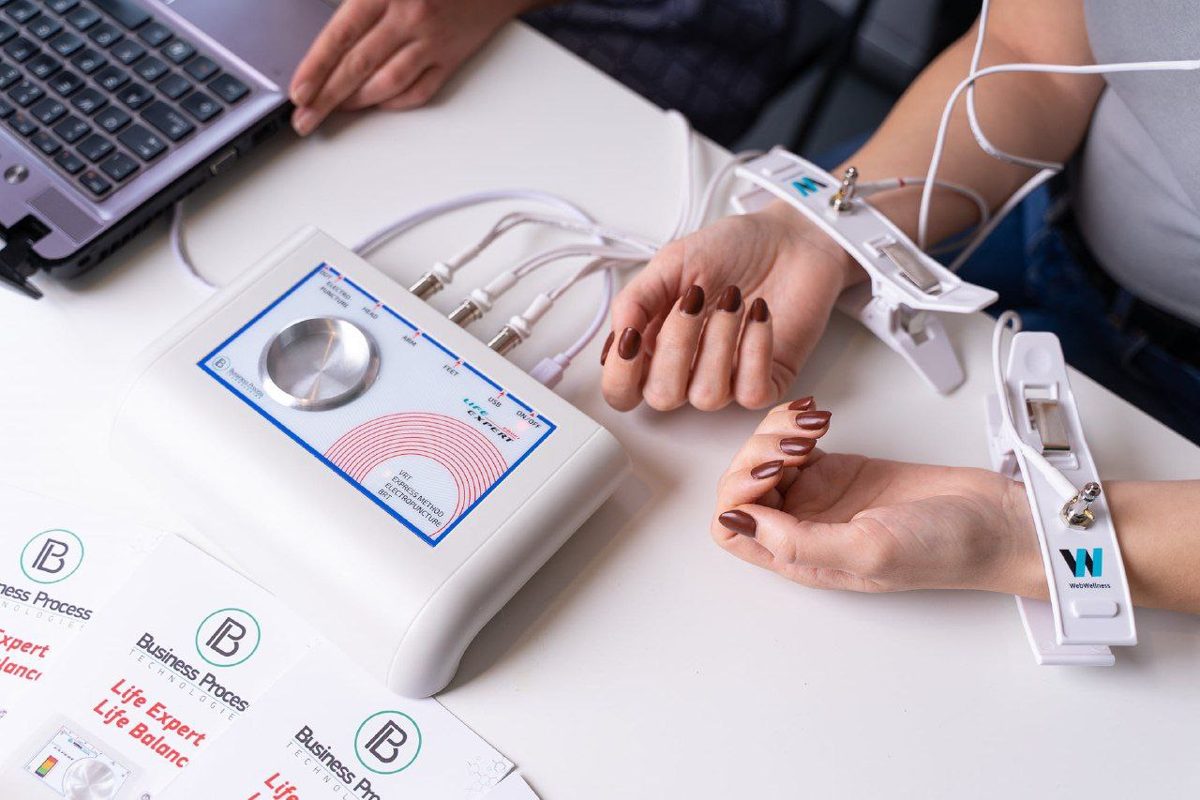
Life Expert 3 records the electrical resistance of the skin at defined contact zones, through electrodes on the hands, feet and forehead. In its rapid mode the measurement takes less than a minute. The readings are processed on the manufacturer's servers and returned as a structured model of forty-seven organs and systems, with further views of the spine, biological age, vitamins and the comparison with earlier sessions.
The value of the instrument does not lie in the number of pages it produces, but in what an experienced reader does with them: identifying the few patterns that recur, placing them in the context of a person's history and complaints, and deciding what deserves attention first. In the Profi workflow, a questionnaire, a short breathing load and a meridian harmonisation add depth to the reading.
A Life Expert 3 session: electrodes connected, the reading processed in the WebWellness software.
Life Balance 2.1: why portability matters
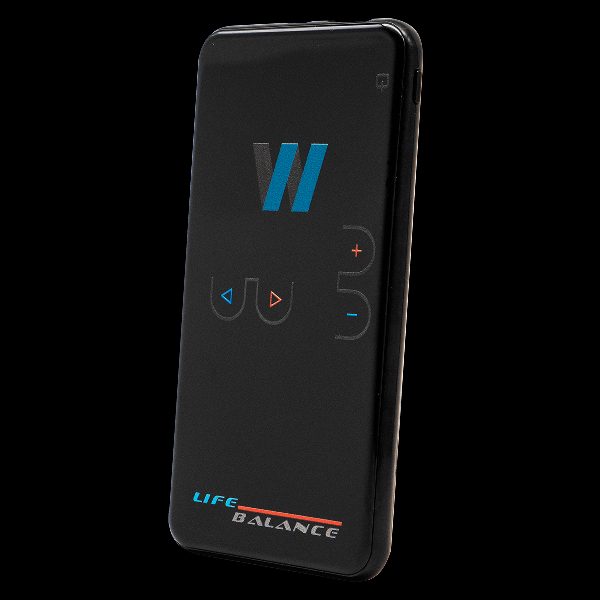
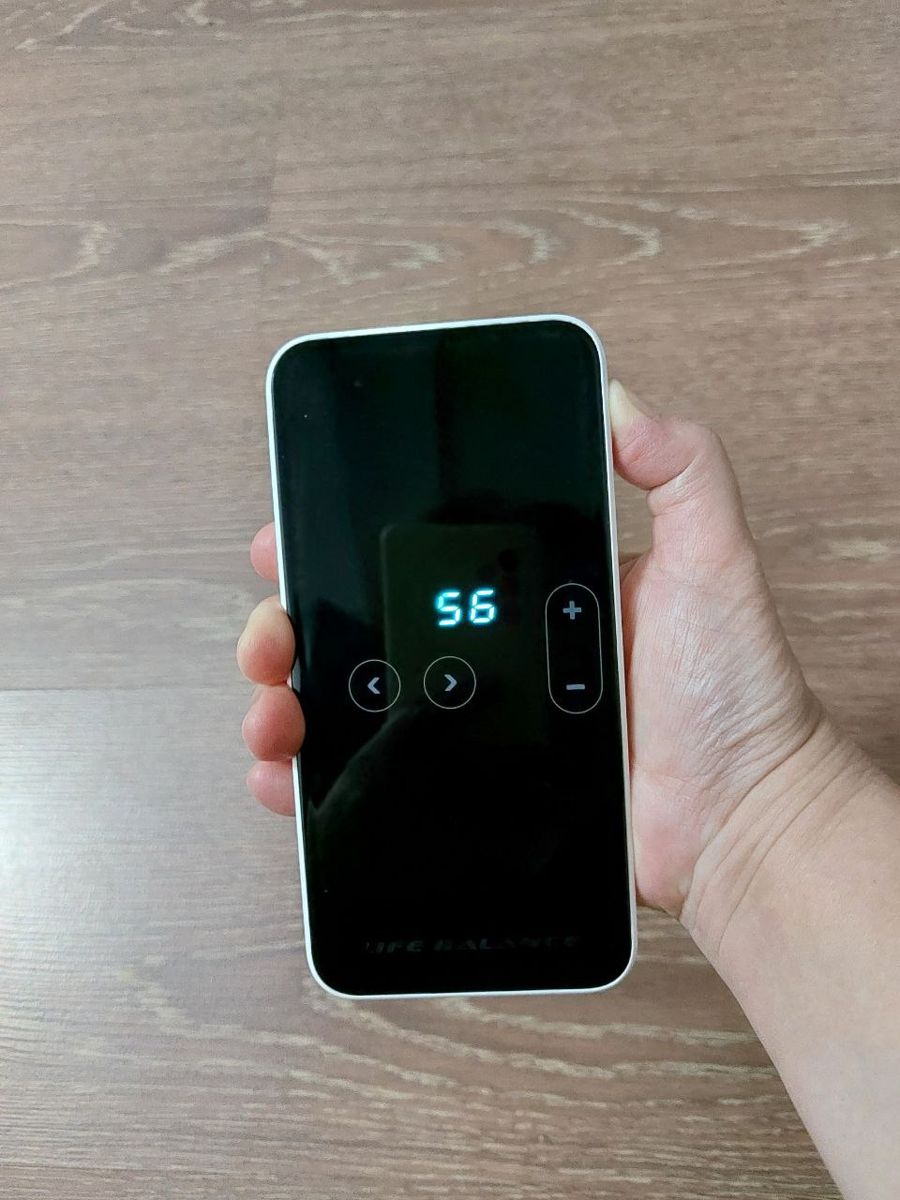
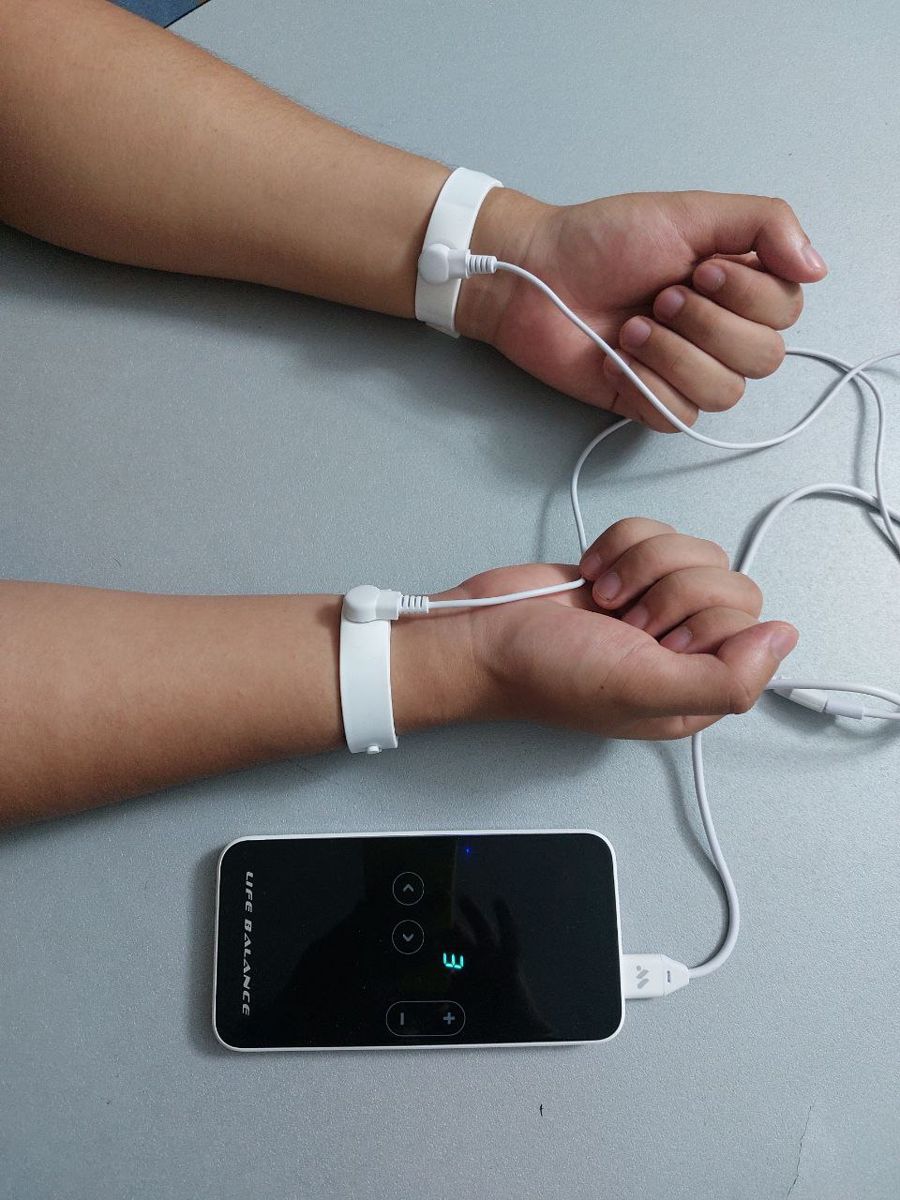
Life Balance 2.1 is the size of a phone. It holds between three hundred and six hundred programmes, from its built-in library and from the complexes written to it after an assessment. It can be used with contact electrodes on the wrists or ankles for a dedicated session, or without contact: in a pocket, on a desk, in a room.
Portability is not a detail of convenience; it is the core of the method. A programme that waits for the next appointment acts once. A programme that travels with you can be repeated at the right moment, in the right setting, for weeks. Regularity allows the body's own regulatory rhythms to meet a stable, repeated input, and it is regularity that makes a change noticeable.
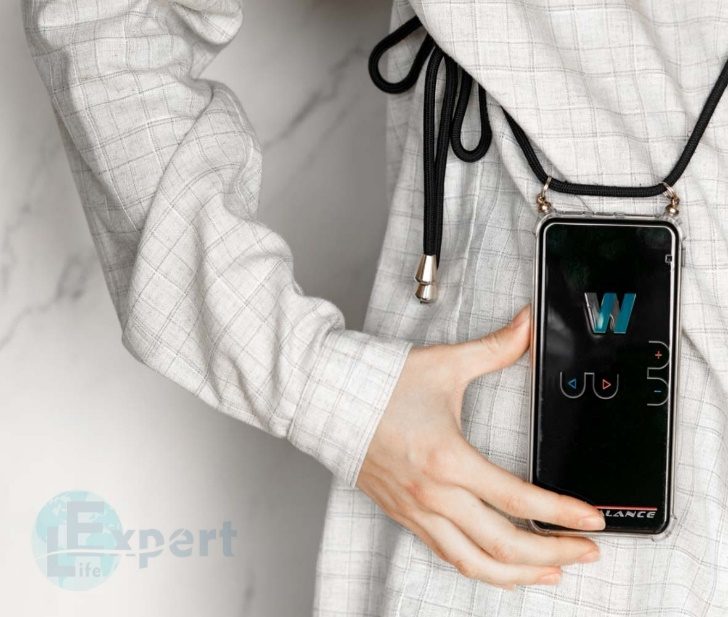
Worn on a cord, it stays with you through the day.Small enough for a pocket or a hand.With wrist electrodes, for the evening session.
Potency: the five levels of Life Balance 2.1
In everyday language, potency suggests strength, and strength suggests that more must be better. In Life Balance 2.1 the five intensity levels describe something more precise. They set how far the device's field reaches when it is used without electrodes, from close contact with the body to a radius of about one and a half metres. Choosing a level is therefore choosing a setting, not a dose.
Choose a level
Level 1 · In a pocket, close to the body
The most intimate setting, and the most economical for the battery. Suited to the moving parts of the day, in an inner jacket or trouser pocket: commuting, walking, running errands.
Example: on the train to work, the device in an inner pocket, a calming programme running quietly while you read.
Level 2 · On the body, a little further
For the device worn on a cord around the neck, clipped to a belt or carried in a bag against the body. A slightly wider reach for the moments when it is not pressed directly against you.
Example: a morning of errands, the device worn on a cord, as in the photograph above.
Level 3 · On a desk or dashboard
The device rests near you while you sit: at your desk, on the table during a meal, on the dashboard of a car. Suited to long, still stretches of the day.
Example: two hours of concentrated work, Life Balance beside the keyboard.
Level 4 · Up to about one metre
For a calm moment in an armchair or on the sofa, the device on a side table. The radius now covers the whole seated body.
Example: reading in the evening, the device on the side table, before the dedicated session.
Level 5 · Up to about one and a half metres
The widest radius, for a quiet room: stretching on a mat, meditation, a slow-breathing practice. It uses the battery fastest, so it is kept for shorter, intentional moments.
Example: twenty minutes of slow breathing on a mat, on a Sunday morning.
Battery use
The practitioner's rule: start at a low level and increase gradually. Higher levels use the battery faster. Choose the level that fits the setting, not the highest one available. The levels follow the WebWellness instructions and Volume II, Reading the Human System.
How it helps in daily life: feeling the results
Results in this kind of work are rarely spectacular in a single day. They are felt as an accumulation: an evening that settles more easily, a morning that begins with more clarity, a digestion that occupies the mind less, a quicker return to calm after a demanding meeting. These are small changes, and precisely because they are small, they deserve to be observed with method.
We therefore ask three simple things. First, keep the dedicated session at a fixed time: twenty unhurried minutes in the evening, the first five spent breathing slowly at about six breaths per minute, a rhythm that physiological research associates with resonance in heart rate variability (Lehrer & Gevirtz, 2014). Second, write two lines a day in a short diary: sleep, energy, digestion, mood, anything you notice. Third, return for a re-test under the same conditions after three to four weeks, so that what you feel can be set beside what is measured.
What you feel and what is measured are two different witnesses. When they agree, we listen carefully.
A day with Life Balance 2.1
07:30
Morning
Level 1, inner pocket. The programme runs during the commute.
Level 4, on the side table while reading. Two lines in the diary.
Three examples from practice
The situations below are typical of the people who come to the practice. They show how the method is adapted to a life, and not the other way round.
The demanding working week
Long days at a screen, little time for oneself. The assessment takes place on a Saturday; the complex is reviewed together and loaded. During the week, Life Balance travels in a jacket pocket at level 1 and rests on the desk at level 3. The only fixed commitment is the evening session with electrodes. The diary records the time of falling asleep and the energy on waking.
The parent at home
Days organised around other people's timetables. In the morning the device is worn on a cord at level 2, and the dedicated session moves to the moment the house falls quiet. Because the protocol is portable, it adapts to the day instead of competing with it.
The active person in recovery
Training, travel, irregular rest. The complex is built from an assessment taken at least two hours after the last meal and well away from a training session, so that the reading is comparable. Life Balance runs at level 5 during stretching on the mat and at level 4 in the evening. Re-tests are scheduled under the same conditions, at the same time of day.
What this practice brings into your life
Attention
An unhurried consultation in which your history is heard before anything is measured.
Understanding
Your results explained in plain words, in your language, with what is measured kept apart from what is inferred.
Continuity
Sessions compared over weeks and months, so that change becomes visible rather than imagined.
A ritual
Twenty calm minutes each evening: a structure many people come to value as much as the programme itself.
Participation
You take part: you choose the setting, keep the diary and see your own progress.
Freedom of movement
A device that fits in a pocket, so the work goes where your life goes.
Above all, the pairing of Life Expert 3 and Life Balance 2.1 changes the relationship a person has with their own well-being. It moves from the occasional consultation to daily participation, from a single image to a story told over time. That is the practical meaning of a new approach: not a promise of certainty, but a method for noticing, supporting and following change with care.
References mentioned Lehrer P.M. & Gevirtz R. (2014). Heart rate variability biofeedback: how and why does it work? Frontiers in Psychology, 5:756. · Kaptchuk T.J. et al. (2008). BMJ, 336:999. · WebWellness, instructions for Life Expert 3 and Life Balance 2.1. · Radian J.B., Reading the Human System (Volume II).
Complementary, never a replacement.These methods are not recognised by conventional medicine as diagnostic tools. A session never replaces your doctor, a laboratory test or a treatment you are following.