
The human body is chemical, but it is never only chemical. Every heartbeat is electrical before it becomes mechanical. Every nerve impulse depends on a controlled movement of ions across a cell membrane. The brain can be observed through electrical rhythms, the heart through its electrical conduction, and muscles through their electrical activity. Modern physiology therefore gives us a far richer picture than the old opposition between “matter” and “energy” might suggest: living systems organize themselves through chemistry, electricity, timing, communication and feedback.
This is the intellectual space in which NLS bioresonance operates.
NLS—short for Non-Linear System—is a non-invasive form of functional assessment that examines the body through patterns of oscillation, regulation and spectral similarity. Instead of asking only, “Is a laboratory value inside or outside its reference range?”, it asks a different question: “How stable, adaptive and coherent does this biological system appear at this moment?”
That distinction matters. NLS is most useful when it is understood not as a digital replacement for medicine, but as an additional language through which an experienced practitioner can study relationships: between organs, regulatory systems, stress responses, symptoms, lifestyle and changes over time.
The model behind NLS
At the biological level, cells maintain measurable electrical potentials across their membranes. Networks of cells coordinate through ion channels, gap junctions and electrical gradients, and modern bioelectricity research has shown that these signals participate not only in nerve and muscle function but also in tissue organization, healing and regeneration. The work reviewed by developmental biologist Michael Levin and others has helped bring endogenous bioelectric signalling back into serious scientific discussion. (Levin, 2021; Adams & Levin, 2013)
NLS extends this perspective into a systems model. It does not assume that an organ possesses one fixed, isolated frequency, as if the liver or pancreas could be reduced to a single musical note. A living organ produces a complex and continuously changing pattern. Metabolism, circulation, nervous regulation, inflammation, fatigue, compensation and environmental stress may all influence that pattern.
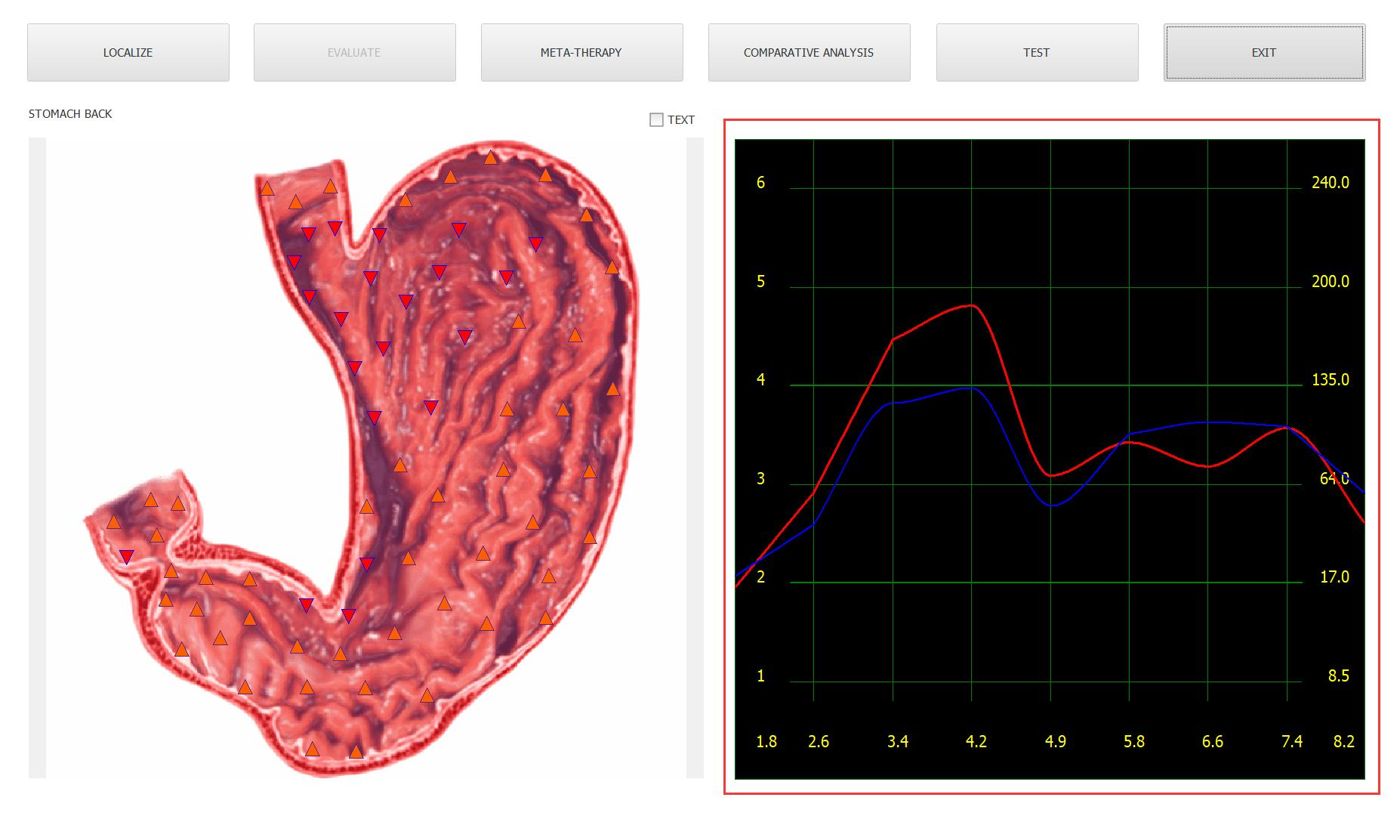
Within NLS terminology, a loss of functional order is often described through entropy. Here, entropy is not used as a direct laboratory measurement of thermodynamic entropy. It is a computational indicator within the software model: a way of expressing increasing disorder, reduced adaptation or movement away from a reference pattern. The coloured markers seen on an anatomical image are therefore not decorative symbols and should not be read as isolated diagnoses. They are the beginning of interpretation—an invitation to examine where the pattern is stable, where it is compensating, and where several findings begin to form a coherent hierarchy.
How an NLS scan works
Although platforms differ, most NLS systems bring together four elements: a headset or sensor interface, an electronic unit, analysis software and a large library of reference patterns, traditionally called etalons.
The headset is often described too casually as a pair of headphones. In reality, it houses the system’s inductive or trigger-sensor interface. Depending on the hardware architecture, it participates in the controlled signal-and-response process through which subtle physiological information is acquired. The manufacturer of the original Metatron line describes its trigger sensor as capturing small signal fluctuations, converting them into a digital sequence and transmitting that information to the computer for processing. (Institute of Practical Psychophysics: device principle)
The central nervous system has an important place in the NLS model because it is the body’s principal integrative network, continuously receiving and coordinating information from the organism. The reference library, however, is held in the software. The measured response is processed through non-linear mathematical analysis and compared with stored spectral models representing organs, tissues, physiological processes and other reference categories.
The software then converts a difficult mathematical comparison into something the practitioner can navigate: three-dimensional anatomical models, coloured markers, spectral curves, entropy stages, similarity coefficients and comparative functions. Different systems use different scales and graphical conventions, but the principle is consistent. The image is a map of calculated relationships—not a photograph of the tissue.
This is why the practitioner remains essential. A single marker has little value outside context. A meaningful assessment emerges by checking whether the same tendency appears across related structures, whether it corresponds to the client’s history and symptoms, whether technical artefacts can be excluded, and whether the finding remains coherent when the examination is repeated under comparable conditions.
From Metatron to Hunter and Biophilia
The modern NLS lineage is most clearly associated with the Institute of Practical Psychophysics in Omsk, founded in 1990 under Vladimir Nesterov. Its Metatron systems established much of the visual and analytical language later recognized throughout the field: organ models, trigger sensors, spectral comparison, etalons, entropy analysis and information correction.
Three names appear repeatedly today:
- Metatron refers to the original and continually developed family associated with the Institute of Practical Psychophysics.
- Hunter 4025 describes a widely distributed branch of NLS hardware and software. Because versions and suppliers differ, provenance, hardware quality, software integrity and practitioner training matter more than the model name alone.
- Biophilia Tracker represents a later, software-rich evolution of the NLS approach, with extensive anatomical navigation, reference libraries, comparative analysis, vegetative testing and therapy functions. Its value lies not simply in the number of available screens, but in the operator’s ability to reduce a large volume of information to a clinically intelligible pattern.
NLS is frequently linked in promotional histories to Soviet or Russian aerospace-oriented research. That connection may describe part of the scientific environment from which the technology emerged, but the publicly traceable commercial history is firmer from the early 1990s onward. A mature account of NLS does not need mythology: the documented development of the systems, their increasingly sophisticated software and the accumulated experience of trained practitioners are substantial enough.
Assessment and meta-therapy are not the same function
An NLS session may contain two distinct stages.
The first is assessment. The practitioner studies functional patterns, relationships and priorities. A lower level of organization in one structure does not automatically name a disease, and an etalon with high spectral similarity does not become a confirmed clinical finding merely because it appears near the top of a list. Interpretation depends on pattern convergence, history, symptoms, cross-checking and reassessment.
The second is meta-therapy, sometimes called meta-correction or information correction. Within the NLS model, the system uses a modulated signal intended to oppose or stabilize a disordered pattern and support a more coherent regulatory response. The guitar analogy is useful here, provided it is not taken too literally: the aim is not to force the instrument to play a new song, but to offer a reference against which it may return toward better tuning.
The most responsible practitioners do not judge this process by the animation on the screen. They look for a meaningful response: improved stability in repeat testing, a more coherent pattern across related structures and, above all, a change that makes sense in the person’s actual condition. Meta-therapy is strongest when it is integrated into a broader plan that may include nutrition, sleep, movement, stress regulation, supplementation and appropriate medical investigation.
Where NLS fits in modern integrative care
The research base for bioresonance is developing but remains heterogeneous, and NLS-specific systems still require better standardized protocols and independent replication. That is not a reason to dismiss the field; it is a reason to study it more carefully. Published clinical work already includes, for example, a double-blind, placebo-controlled trial involving 190 smokers that reported better cessation outcomes in the active bioresonance group, as well as controlled research in functional gastrointestinal complaints. These studies do not validate every device, mechanism or application, but they demonstrate that bioresonance can be investigated through serious clinical methodology. (Pihtili et al., 2014; Nienhaus & Galle, 2006)
Integrative medicine itself is moving toward a more evidence-informed, person-centred and preventive model. The World Health Organization’s 2025–2034 strategy explicitly calls for stronger evidence, appropriate regulation and the thoughtful integration of safe and effective traditional, complementary and integrative approaches into health systems. (WHO Global Traditional Medicine Strategy 2025–2034)
NLS belongs naturally in that conversation because it encourages the practitioner to look at the person as a network rather than a collection of disconnected organs. Its practical strength is not the promise of instant certainty. It is the capacity to organize complex information, identify functional priorities, generate better questions and follow change over time.
In other words, NLS is less about predicting catastrophe than about recognizing loss of regulation while there may still be room to respond intelligently. It listens for the quieter changes—the body’s whispers—before they become impossible to ignore.
Levin M. (2021); Adams D.S. & Levin M. (2013); Pihtili A. et al. (2014); Nienhaus J. & Galle M. (2006); WHO Global Traditional Medicine Strategy 2025–2034; Institute of Practical Psychophysics, device principle.